
Blog
Notes on the career readiness report

6 min read
Never Use Zero to Mean Not Applicable
Never code “not applicable” as zero. It changes averages, hides missing data, and can turn a clean survey into a misleading report.
Read the post-

6 min
How Many Raters Do You Actually Need Per Student?
One rater can be useful, but it is a weak basis for 360 feedback. Two or more raters improve reliability, and single-rater results need careful labeling.
-

7 min
Designing Pre and Post Assessment That Actually Shows Growth
Design pre and post assessments to detect real growth, including response-shift bias and when a retrospective pre-test can improve interpretation.
-

7 min
How to Run a Career Readiness Assessment Window
Run a career readiness assessment window by setting a fixed calendar, recruiting supervisors early, following up in rounds, and closing with a clear reporting plan.
-

6 min
Closing the Loop: The Step Programs Keep Failing
Closing the loop requires a stable assessment instrument, or programs cannot tell whether a change improved results or just changed the measure.
-

5 min
Should Faculty Rate Students on Career Readiness?
Faculty should rate students on career readiness for course-based experiences, but their view is strongest on preparation and weakest on workplace behavior.
-

5 min
Presenting Assessment Data to a Provost
A provost wants a clear decision-ready summary, limited method detail, and the weakest competency up front because it builds trust.
-

7 min
Designing Cohorts So Your Data Answers a Question
Cohort design determines what your assessment data can actually answer, from major-level comparisons to term trends and experience-specific outcomes.
-

5 min
What Changed in the 2021 NACE Competency Revision
In 2021, NACE reduced its competencies from nine to eight by folding Global and Intercultural Fluency into Equity and Inclusion and renaming Digital Technology as Technology.
-

7 min
What Regional Accreditors Expect on Student Outcomes
Regional accreditors expect clear student learning outcomes, evidence students achieve them, and proof that results are used to improve programs.
-

7 min
On-Campus Jobs Are Career Readiness Experiences
On-campus jobs are already a career readiness experience, and institutions can measure them with simple supervisor feedback, student reflection, and existing workflows.
-

6 min
The Problem With Student Self-Report Data
Student self-report data is useful for perceptions and reflection, but it is weak evidence for actual skill unless paired with outside observation.
-
6 min
Comparing Career Readiness Across a System or Consortium
Cross-campus career readiness comparisons only work when the instrument, timing, rater mix, and response rates are held constant.
-

6 min
Getting Employers to Actually Complete Student Evaluations
Employer evaluation response rates rise when the request is short, timed to the work experience, sent by the right supervisor, and open without a login.
-

5 min
High-Impact Practices and Career Readiness: Is the Link Evidenced?
High-impact practices are associated with stronger career outcomes, but selection effects make simple before-and-after claims unreliable.
-

5 min
The Career Readiness Data Career Services Should Actually Track
Track career readiness by competency, cohort, and major, not just event counts, if you want outcomes data that supports program decisions.
-

6 min
Why Eight Competencies and Not Eighty
Eight well-defined competencies usually produce better data than a long bespoke list, because they reduce rater fatigue and improve comparability.
-

6 min
Self-Assessment vs Employer Ratings: Why the Gap Matters
The difference between student self-assessment and employer ratings shows where confidence, calibration, and supervision need attention.
-

6 min
Career Readiness Assessment at a Community College
A community college career readiness assessment should count work, campus jobs, and short-term projects, not just traditional internships.
-

6 min
Career Readiness Evidence for AACSB Accreditation
AACSB assurance of learning can include career readiness when you treat employer ratings as direct evidence in a clearly defined assessment cycle.
-

7 min
How Students Should Talk About Competencies in Interviews
Students should describe a specific situation, action, and result in interviews, then name the competency only if the interviewer needs the label.
-

6 min
Frequency Scales Beat Agreement Scales for Competency Items
For competency items, frequency scales usually produce more reliable ratings than agreement scales because they ask about observable behavior, not self-concept.
-

6 min
Embedding Career Readiness in the Curriculum, Not Beside It
Course-embedded career readiness reaches every student where learning already happens, while revealing the real cost to faculty time and course design.
-

6 min
Career Readiness, Employability Skills, Soft Skills: Do They Mean the Same Thing?
Career readiness, employability skills, soft skills, and durable skills overlap heavily, but they are not identical terms and the differences matter in practice.
-

6 min
Career Readiness Evidence for Graduate and Professional Programs
Graduate and professional programs need evidence of career readiness that shows professional identity, supervised practice, and accredited outcomes, not just job placement.
-

6 min
Your Response Rate Is 30 Percent. Now What?
A 30 percent response rate can still support useful findings if you test for non-response bias and state the limits clearly.
-

6 min
The Employer Evaluation Request Email, Line by Line
A strong internship supervisor evaluation email is short, specific, and honest about time, sender, and deadline, with one clear call to action.
-

6 min
Launching an Assessment Program With No Budget
You can launch a credible assessment program at zero budget if you limit scope, use existing tools, and spend staff time on process instead of software.
-

6 min
Mapping Competencies to Program Learning Outcomes Without Fudging It
A defensible competency-to-outcome map shows where evidence is direct, where it is partial, and where a program still needs data.
-
6 min
What Employers Say Graduates Lack, and What the Data Shows
Employers often rate communication, teamwork, and problem solving as highly important, but say new graduates are less proficient in those same areas.
-

5 min
Career Readiness Evidence for Online and Adult Learners
For online adult learners, the best career readiness evidence usually comes from current work, with a manager observer, clear consent, and careful question design.
-

7 min
Measuring What Students Actually Learn From an Internship
Hours logged and completion rates show participation, not learning. Measure specific competencies, supervisor evidence, and final growth at the placement.
-

7 min
FERPA and Career Readiness Data: What Actually Applies
FERPA often applies to career readiness data held by a school, but the details depend on whether the data are education records, vendor access, and who provided the rating.
-

7 min
Running Assessment Without an Institutional Research Office
A one-person assessment operation can still produce credible evidence if it automates routine data pulls, narrows the scope, and documents limits clearly.
-

4 min
Anonymity Thresholds in 360 Feedback, and When They Backfire
Anonymity thresholds in 360-degree feedback require a minimum of three raters, a rule that prevents students with single supervisors from receiving their results.
-

5 min
Writing Behavioral Anchors So Two Raters Agree
Two raters will only agree on a competency score when the assessment scale replaces vague adjectives with observable actions and specific behavioral anchors.
-

5 min
Benchmarking Career Readiness Against Peer Institutions
Valid career readiness benchmarking requires exact instrument stability, precise cohort definitions, and statistically significant group sizes to yield reliable data.
-

5 min
Mapping ABET Student Outcomes to Career Readiness Competencies
Mapping ABET Student Outcomes to NACE competencies aligns technical criteria with behavioral evidence to streamline program assessment and continuous improvement.
-

5 min
Direct vs Indirect Evidence: What Reviewers Actually Mean
Direct evidence evaluates a student's actual performance, while indirect evidence relies on perceptions. Knowing the difference determines your data's credibility.
-

5 min
Helping Students Read Their Own Career Readiness Results
Advisers can help students interpret career readiness results by framing scores as a snapshot of current workplace behavior rather than a verdict on potential.
-

5 min
Running Career Readiness Assessment as a One-Person Office
A solo career director can run a valid readiness assessment by limiting scope to one cohort, setting a strict three-week window, and ignoring qualitative coding.
-

4 min
Tracking the Same Student Across Four Years
Longitudinal tracking of student career readiness requires navigating attrition, instrument drift, and data silos to yield actionable insights for accreditation.
-
5 min
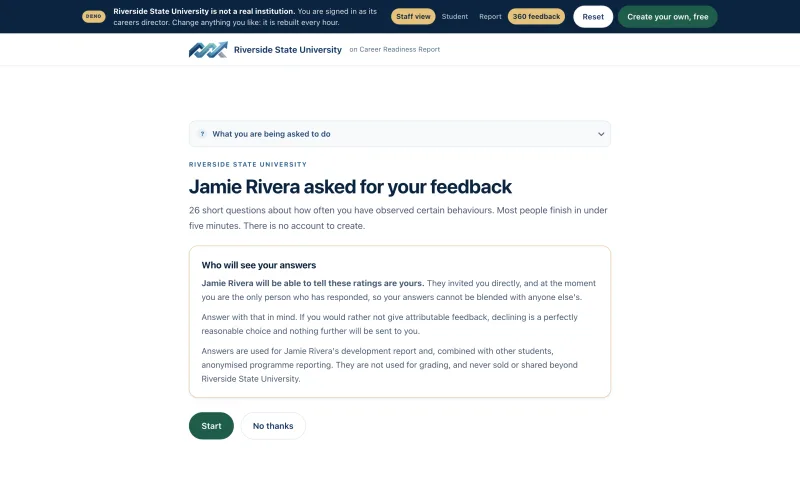
What Data Goes Into a Career Readiness Report
A career readiness report synthesizes student self-assessments, supervisor evaluations, and logistical experience data to accurately measure NACE competencies.
-
5 min
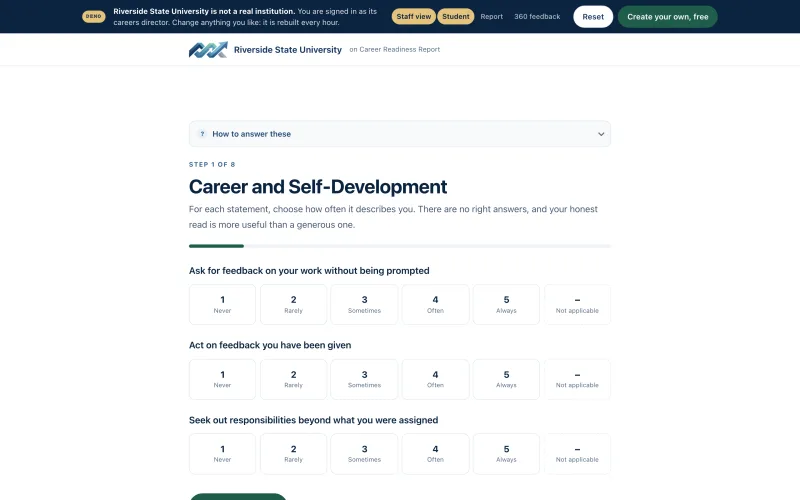
What Students Should Actually Do With Their Report
Students should use their assessment results to write concrete resume bullets, script behavioral interview answers, and choose one specific competency to improve.
-
4 min
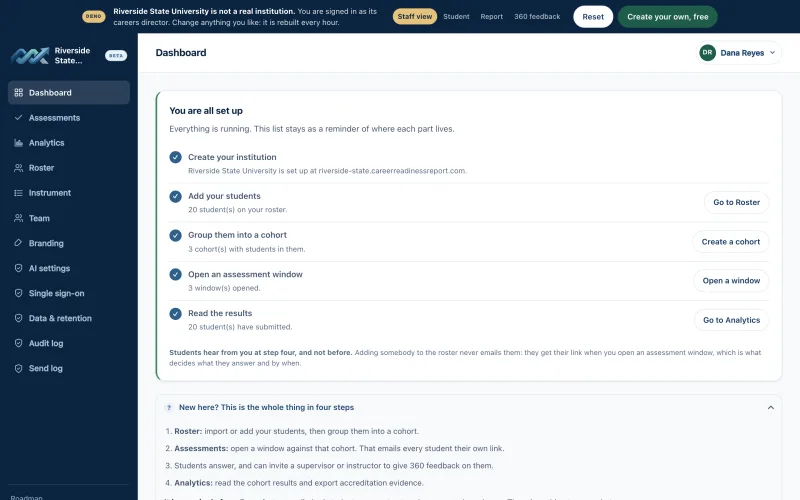
What 'Free' Means for a Career Readiness Report
A free career readiness platform removes budget barriers, per-student fees, and contracts, though universities must still invest staff time in implementation.
-
4 min
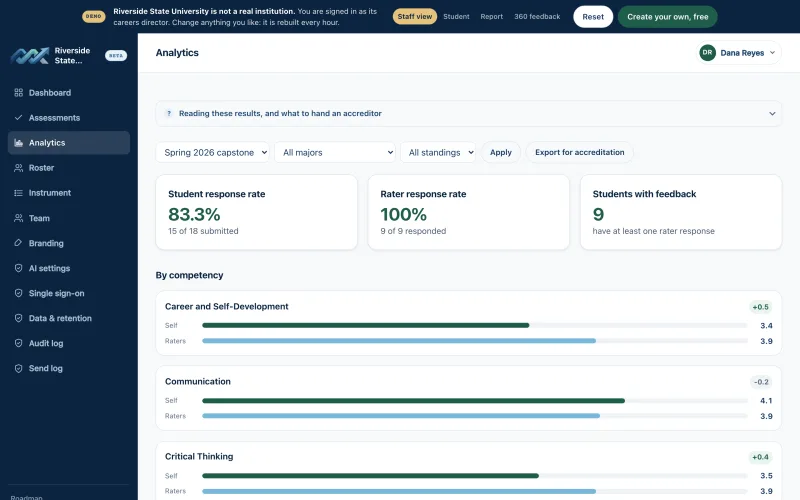
When the Student and the Supervisor Disagree
When a student and supervisor disagree on an evaluation, averaging their scores hides the exact developmental gaps advisors need to build career readiness.
-
4 min
How Often Should You Run a Career Readiness Report?
Assess career readiness immediately after a student completes an experience to maximize supervisor response rates and ensure accurate competency data.
-
4 min
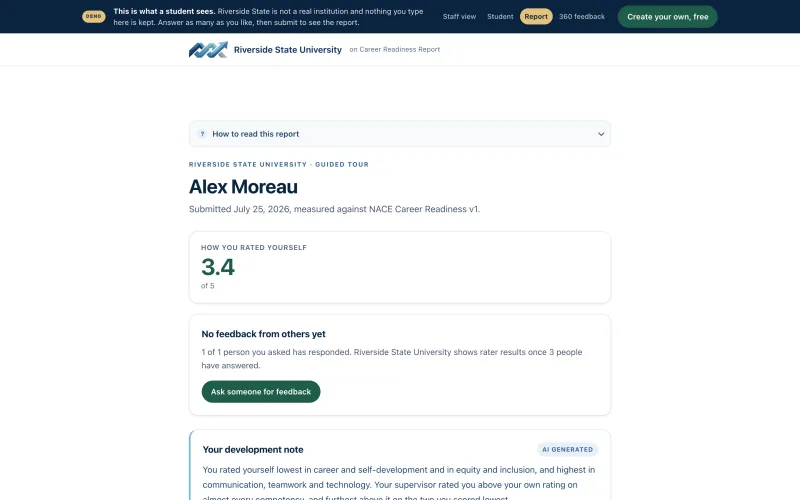
What Is a Career Readiness Report?
A career readiness report is a per-student record of NACE competencies, combining self-assessments with direct feedback from workplace supervisors.
-

5 min
Writing Internship Learning Outcomes You Can Actually Measure
Write internship learning outcomes that site supervisors can actually rate by translating vague professional goals into observable behaviors tied to competencies.
-

5 min
How to Get Internship Supervisors to Actually Respond
Boost internship supervisor evaluation response rates by eliminating account creation, sending timed requests, and allowing one-click opt-outs.
-

4 min
Assessing Short, Unpaid and Micro-Internships
Assessing micro-internships requires narrowing focus to one or two NACE competencies rather than attempting a full profile in a forty-hour experience.
-

7 min
Asking Employer Partners for Ratings Without Losing Them
Treat employer evaluations as a relationship asset, not a data grab, by minimizing burden and returning useful aggregate insights every term.
-

7 min
Replacing a Homegrown Career Readiness Survey
Homegrown Qualtrics or Google Forms surveys are useful, but purpose-built tools can add observer ratings, stable instruments, and better data over time.
-

7 min
HECVAT, VPAT and DPA: What Procurement Will Ask You For
Understand HECVAT, VPAT and DPAs so you can bring new career tools to procurement with the right documents, people and timing already lined up.
-

8 min
How to Evaluate Career Readiness Software
Use this practical question-based checklist to compare career readiness software options and document a defensible, campus-ready selection.
-

6 min
Making the Budget Case for Measuring Career Readiness
To win budget for career readiness assessment, tie requests to retention, placement, accreditation risk, and the cost of unanswered questions.
-

7 min
Due Diligence on Free Software in Higher Education
Security teams should treat free software like any other vendor: follow the money, trace the data, model disappearance, and define a clean exit.
-

5 min
What Career Readiness Assessment Actually Costs
Career readiness assessment is priced four ways, and the sticker price is rarely the largest line. Here are the six costs that belong in a real comparison.
-
5 min
Using a Career Readiness Report as Accreditation Evidence
What AACSB, ABET and regional reviewers want from a career readiness report: a stated outcome, an aligned measure, results against a target, and a documented change.
-

5 min
Career Readiness Report or Co-Curricular Transcript?
A co-curricular transcript verifies what a student did. A career readiness report documents how well they did it, and who judged. Here is when each one works.
-

5 min
Sharing a Career Readiness Report With an Employer
A career readiness report rarely belongs in a job application. It belongs in interview prep, in offer conversations, and always under the student's control.
-
5 min
Reading Career Readiness Data Across a Whole Cohort
Which cohort-level cuts of career readiness data actually change decisions, which are statistical noise, and why department averages built on unequal response rates mislead.
-

5 min
Getting Faculty Buy-In for Career Readiness Assessment
Faculty resistance to career readiness assessment is usually rational. Here is what to offer in exchange for their time, and what to stop asking them to do.
-

6 min
What to Do About Supervisors Who Rate Everyone Excellent
Leniency and range restriction are different problems. Fix the compressed variance with behavioral anchors, within-student differentiation, and distribution reporting.
-
5 min
How to Read a Career Readiness Report
A first-time reader's walkthrough of a career readiness report: why the overall rating tells you least, what the per-competency spread reveals, and how to handle skipped items.
-

5 min
Can You Assess Career Readiness in a Two-Week Experience?
A two-week placement supports valid ratings on roughly four of the eight NACE competencies. The fix is a shorter instrument, not a watered-down version of the long one.
-
5 min
Who Should Rate a Student, and How Many Raters Is Enough
The direct supervisor is the single most valuable rater. A second buys real reliability; a fourth mostly buys missing data. Here are the numbers behind both.
-

5 min
How to Measure Career Readiness in College Students
Self-assessment, supervisor observation, and artifact review each evidence something different. Here is what each can prove, and why self-report alone will not hold up.
-

6 min
What Are the 8 NACE Career Readiness Competencies?
The eight NACE competencies are Career and Self-Development, Communication, Critical Thinking, Equity and Inclusion, Leadership, Professionalism, Teamwork, and Technology.