
Article
What Students Should Actually Do With Their Report
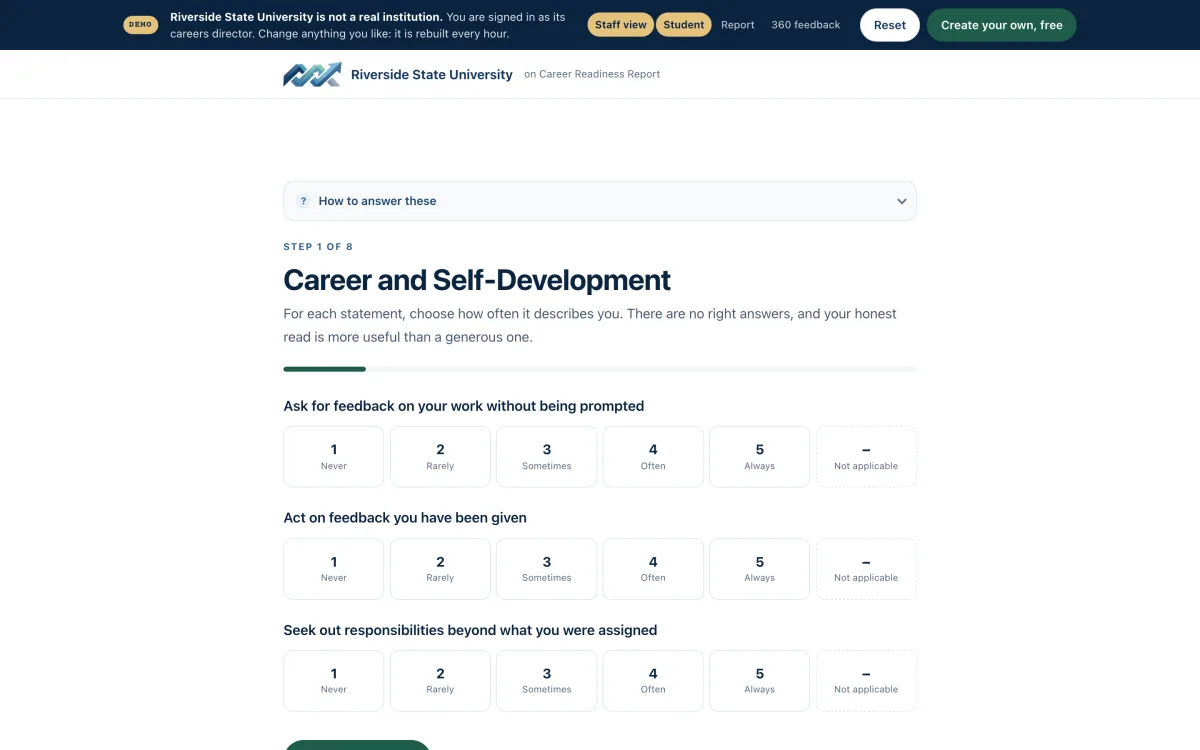
You should use your assessment results to write concrete resume bullet points, script behavioral interview answers, and choose one specific competency to improve during your next semester. The numerical scores give you a baseline of your current professional skills. The qualitative feedback from your supervisor provides the exact vocabulary you need to prove your value to future hiring managers.
Translate High Ratings Into Interview Evidence
When an employer rates you highly in a NACE competency like Communication or Teamwork, they are verifying that you can execute those skills in a real workplace. You must now translate that verification into the language of hiring.
Do not simply write "Excellent Communicator" in your resume skills section. Adjectives do not win job offers. Instead, look at the specific behaviors your supervisor rated highly. If they gave you top marks for explaining technical concepts to non-technical staff, write a resume bullet that reflects this action. For example, you should write "Translated weekly database performance metrics into plain-language summaries for the marketing department." This provides concrete evidence of your communication skills.
Use the same approach for behavioral interviews. Interviewers rely on prompts that begin with "Tell me about a time when you..." You can build your answers directly from your highest-rated competencies. Pick a competency where you scored a four or five. Think of the specific project that earned you that score. Structure your answer using the Situation, Task, Action, and Result framework. If you scored highly in Critical Thinking, describe the exact problem you solved, the analytical steps you took, and the business outcome of your decision. Practice these stories until you can deliver them naturally.
Contextualize Lower Ratings
A low rating is a diagnostic tool. It tells you exactly where to focus your effort before you enter the full-time job market.
You must first understand how supervisors evaluate interns and student workers. Academic grading trains students to view anything below a 90 percent as a failure. Professional performance reviews operate on a completely different scale. When a supervisor gives you a three out of five on a competency, they are not giving you a C. They are indicating that you meet the expectations for someone at your career stage. A five is typically reserved for employees who are performing well above their current pay grade.
Students consistently rate themselves higher than their employers rate them. In a typical cycle using the Career Readiness Report platform, a student might give themselves a five in Professionalism because they showed up on time every day and completed their assigned tasks. The supervisor might give them a three because, while punctual, the student required significant guidance to prioritize their daily workload. The supervisor's rating is strictly calibrated against the demands of the full-time workforce, where employees are expected to manage their own time.
Accept the tradeoffs inherent in 360-degree feedback. You surrender the comfort of a private self-assessment to gain an accurate picture of how the professional world views your work. This visibility can be uncomfortable. If you receive a two in Technology, do not argue with the assessment or blame the employer. Identify the specific software or technical process you struggled with. Then, enroll in a certification course or a campus workshop to address the gap before your next internship.
Prioritize the Supervisor Comments
The numerical ratings categorize your performance. The supervisor comments explain it. A 4.5 in Leadership looks good on a bar chart, but the text box containing your manager's written feedback is the most valuable part of your report.
Employers rarely have time to write extensive commentary. When a supervisor takes the time to write a specific sentence about your work, they are highlighting a trait that genuinely stood out to them. Look for recurring verbs and nouns in their comments. If your manager writes that you "consistently anticipated client questions before meetings," you now have a verified professional trait to highlight in your cover letters. You can use their exact phrasing to describe your work style.
Conversely, read constructive criticism literally. If a supervisor writes that you need to "double-check spreadsheet formulas before submitting financial summaries," they are giving you a specific, actionable directive. This is not a vague comment about your overall attention to detail. It is a precise technical habit you can fix immediately. Implement that feedback on your very next assignment.
Build a Development Plan
Your report is a snapshot of your skills at a specific moment in time. Your next step is to create a realistic development plan based on the results.
Select one competency to maintain and one competency to improve over the next six months. Do not try to fix everything at once. If your highest score was in Equity and Inclusion, look for a new project or a leadership role in a student organization that allows you to apply that skill in a more complex environment. If your lowest score was in Career and Self-Development, schedule a meeting with your academic advisor or a career counselor to map out a clear path for your remaining semesters.
Bring your assessment results to your campus career center. The staff there can help you align your scores with the specific demands of your target industry. A student applying for a software engineering role will need to prioritize different competencies than a student applying for a public relations fellowship. Your report provides the objective data required for a productive advising session.
The Career Readiness Report is free for every college and university. Open now, in beta.
Create your institution