
Article
How Often Should You Run a Career Readiness Report?
You should run career readiness assessments immediately at the end of each individual student experience, rather than on a fixed academic term or annual schedule. Assessing a student exactly when they finish an internship, campus job, or practicum ensures the supervisor can accurately recall specific workplace behaviors. This immediate timing maximizes both the validity of the competency data and the response rate of external employers, though it requires continuous data collection.
The Per-Experience Baseline
Evaluating eight NACE competencies requires specific memories of a student's performance. Supervisors are busy professionals. To accurately rate a student on critical thinking or professionalism, the supervisor needs to draw on recent, concrete examples. Did the student identify a systemic issue when a project stalled? Did they navigate a complex client interaction successfully? Human memory of these behavioral specifics degrades rapidly.
If an evaluation is sent the week an internship concludes, the supervisor can answer these questions accurately. This produces valid assessments of skill levels. If the evaluation is delayed by even a month, the supervisor defaults to a general halo effect. They remember if they liked the student, but they lose the granularity needed to score specific competencies.
The explicit tradeoff here is administrative tidiness. Tying assessments to experience completion means you collect data continuously. An engineering co-op might end in March, while a nursing clinical finishes in May. Your assessment window is always open, which makes rigid reporting periods impossible at the point of collection.
The Per-Term Alternative
Many offices default to end-of-term assessment windows: late November for Fall, late April for Spring, and August for Summer.
This cadence perfectly matches institutional rhythms. It aligns with grading periods, credit hours, and established faculty workflows. When you manage campus-wide assessment, batching the communication into three distinct campaigns allows you to focus resources and drive participation through concentrated messaging.
The weakness of the per-term model is the disconnect between the academic calendar and employer timelines. A student completing a 120-hour internship requirement might finish their hours by week ten of a fifteen-week semester. If you wait until finals week to send the supervisor a feedback request, you have lost the optimal window. The student has been gone for a month, and the supervisor has moved on to other priorities.
Consequently, per-term models often see lower employer response rates compared to per-experience models. The data collected may be easier to sort into fall and spring buckets, but you collect less of it, and the scores rely on older memories.
The Annual Assessment Trap
Running a single annual assessment window in late spring is a common approach for institutions transitioning from basic graduate outcome surveys to competency tracking.
This frequency is highly problematic for 360-degree feedback models. Asking a student to reflect on an entire year of disparate experiences merges distinct skill applications into a single blur. More importantly, attempting to survey an employer in May about a student who worked for them the previous October yields almost no useful data.
Supervisor response rates in annual models typically fall below acceptable thresholds for accreditation reporting. The supervisors who do respond often skip detailed behavioral questions because they simply cannot remember the specifics of the student's daily work from six months prior.
Annual windows serve institutional alumni surveys well. They fail completely as a mechanism for measuring specific, observable career readiness competencies during a student's academic journey.
Decoupling Collection From Reporting
The tension between data validity and administrative simplicity is a structural design decision. Optimizing for valid data requires the per-experience model. Optimizing for easy administration pushes you toward per-term or annual models.
The solution is to separate your collection schedule from your reporting schedule. You can collect data continuously as experiences end, but aggregate that data into fixed academic terms for your internal reporting and accreditation requirements.
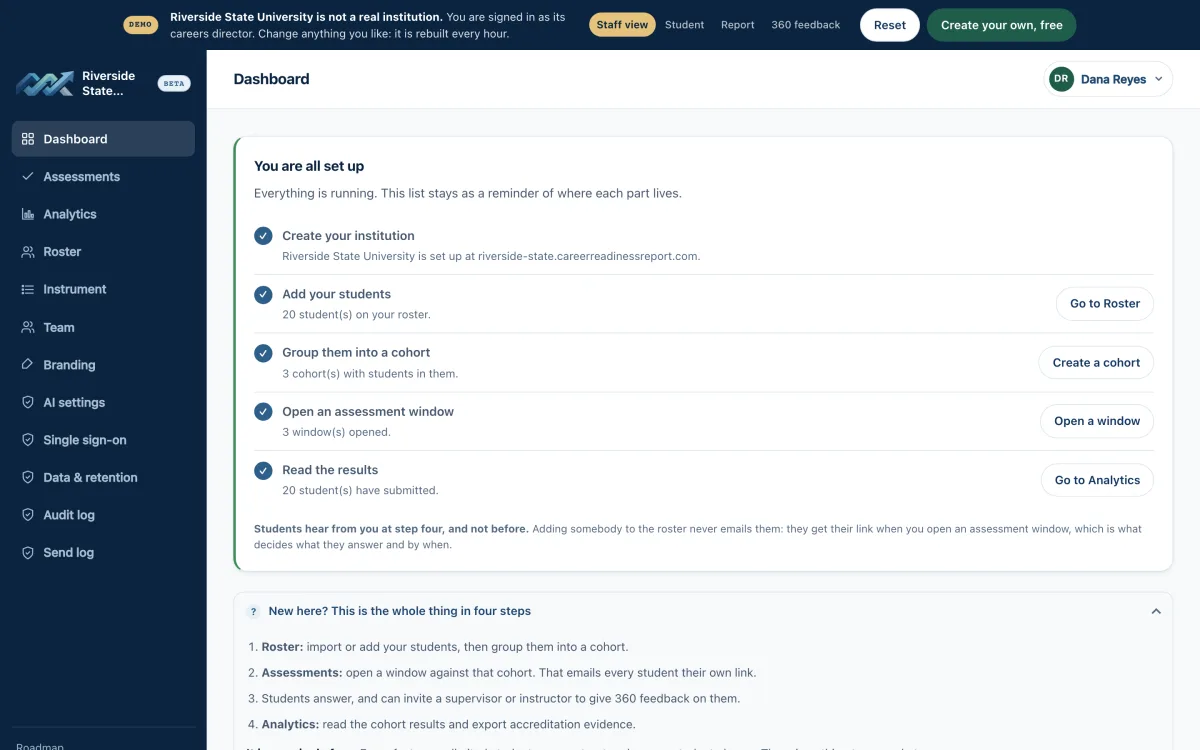
This requires automated infrastructure. Managing a continuous flow of per-experience assessments manually via spreadsheets and generic survey tools requires dedicated administrative staff. Systems like the Career Readiness Report are built precisely for this continuous collection, triggering self-assessments and supervisor feedback requests automatically when a specific experience concludes, regardless of the calendar date.
By anchoring the assessment to the end of the work itself, you capture the employer's attention when they are most invested in the student's outcome. You accept the messy reality of continuous data collection, and in exchange, you secure the high response rates and accurate behavioral data required to prove institutional effectiveness.
The Career Readiness Report is free for every college and university. Open now, in beta.
Create your institution