
Article
What 'Free' Means for a Career Readiness Report
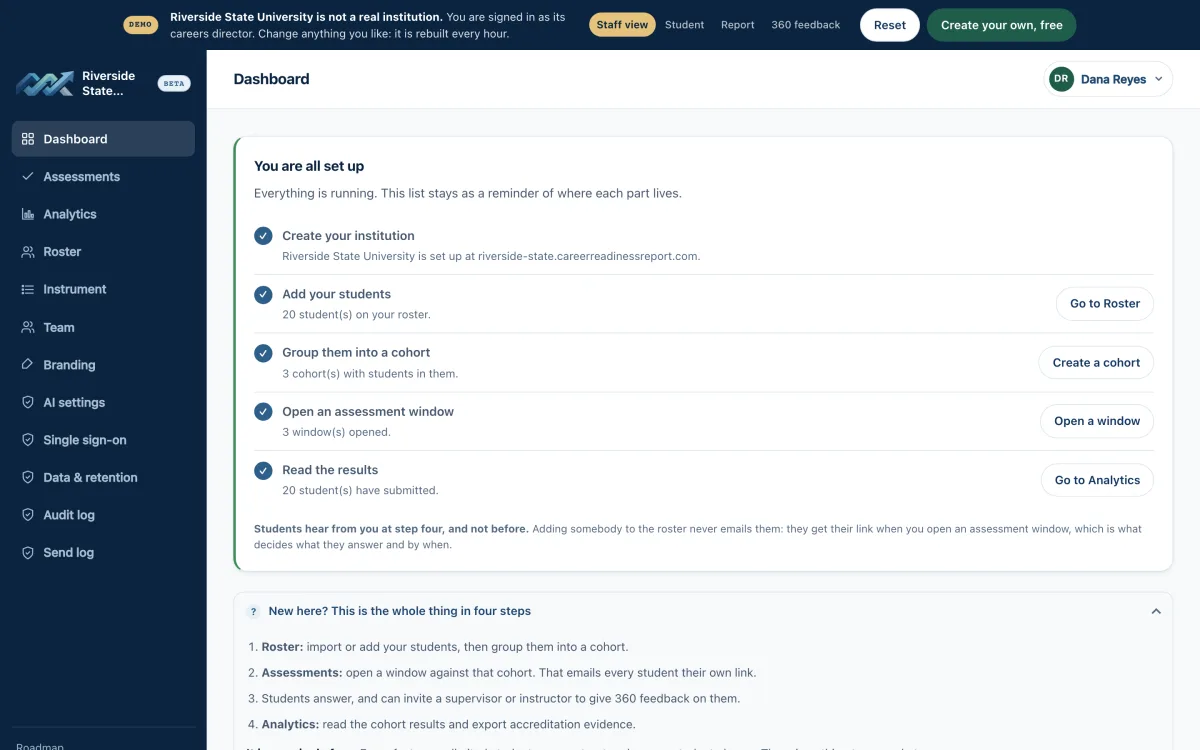
For a college or university, a "free" assessment platform means there is no per-student fee, no annual contract, and no paid tier gating the reports. An institution pays zero dollars to create an account, administer the assessments, collect the 360-degree feedback, and download the resulting accreditation-ready benchmarks. The financial cost is entirely removed from the procurement process.
When a career services director brings a zero-dollar tool to procurement, the immediate question is how the vendor makes money and what hidden costs exist. In this model, there is no invoice. A university does not sign a multi-year agreement. There is no trial period that converts into a $15,000 annual subscription once a certain number of students complete their NACE competency self-assessments. The absence of a contract means the institution is not locked into a proprietary ecosystem.
Institutional Resource Requirements
Removing the software licensing fee does not make the implementation cost-free. Deploying any campus-wide assessment requires institutional resources, primarily in the form of staff time. Career services, IT, and institutional research departments must still allocate hours to make the initiative successful.
First, data governance requires dedicated attention. Even without a financial transaction, IT security and university legal counsel must review the platform to ensure it complies with the Family Educational Rights and Privacy Act. They must verify data storage protocols, encryption standards, and user access controls. This review process can take several weeks and requires coordination between the vendor's documentation and the university's risk management framework.
Second, the platform handles the mechanics of distributing assessments, but staff must manage the relationships. The assessment relies on 360-degree feedback from internship supervisors, faculty, and employers. While the software sends the automated requests and reminders, career services professionals must prime these stakeholders to participate. An employer is more likely to complete a rubric evaluating a student's critical thinking and communication skills if the university's employer relations team has already explained the value of the exercise.
Finally, institutions must dedicate resources to acting on the results. An assessment generates benchmarks, but those benchmarks are useless if faculty do not integrate them into curriculum design or if career advisors do not use them in coaching sessions. Interpreting the data and adjusting institutional practices requires faculty time and administrative support.
The Longevity Question
The most reasonable objection to a free software platform is the risk of disappearance. Procurement officers and IT directors know that hosting, maintaining, and supporting a secure platform costs a significant amount of money. If a university relies on a free tool for its accreditation reporting, it faces the risk that the provider could shut down the service, leaving the institution scrambling to find a replacement before the next accreditation cycle.
This is a genuine vulnerability. The Career Readiness Report is built and maintained by Champlin Enterprises, and the platform is funded entirely by the parent company rather than by university subscriptions. While this removes the budget barrier for colleges, it means the platform's existence depends on that continued corporate subsidy. If the business priorities change, the free service could theoretically be discontinued. Institutions must weigh the benefit of a zero-dollar budget line against the lack of a legally binding service level agreement that guarantees the software will exist in ten years.
The primary mitigation for this longevity risk is absolute data portability. Because there are no paid tiers gating the reporting features, universities have unrestricted access to export their raw data and historical benchmarks. Best practice dictates that institutional research teams download their NACE competency data at the end of every semester. If the platform were to cease operations, the university would retain full ownership and possession of its historical records, allowing it to migrate those files to a different system without losing years of longitudinal data.
Data Privacy
Another common concern regarding free software is the assumption that the user is the product. In consumer technology, free applications typically monetize user data through targeted advertising or by selling demographic profiles to third-party data brokers. This model is fundamentally incompatible with higher education data privacy standards. A compliant free assessment tool must explicitly prohibit the sale, licensing, or monetization of student and employer data. The platform acts solely as a data processor, while the university remains the sole data controller.
Operating without a financial contract simplifies the pilot process for academic departments. Faculty running localized internship programs can adopt the tool for a single cohort of fifty students to test the employer feedback loops. If the rubric proves useful, the department can expand the rollout. If the return rates from internship supervisors are too low to provide statistically significant benchmarks, the department can abandon the initiative without having wasted departmental funds or requiring approval to break a contract.
Ultimately, free software shifts the focus from procurement to execution. When career services directors no longer need to justify a line item in the annual budget, they can reallocate that persuasive effort toward campus stakeholders. Faculty must be convinced to embed the assessments into their syllabi, and employer relations teams must coach industry partners on providing constructive 360-degree feedback. The work of measuring career readiness remains demanding, but the absence of a licensing fee ensures that every hour invested goes toward institutional improvement rather than vendor negotiations.
The Career Readiness Report is free for every college and university. Open now, in beta.
Create your institution