
Article
What Data Goes Into a Career Readiness Report
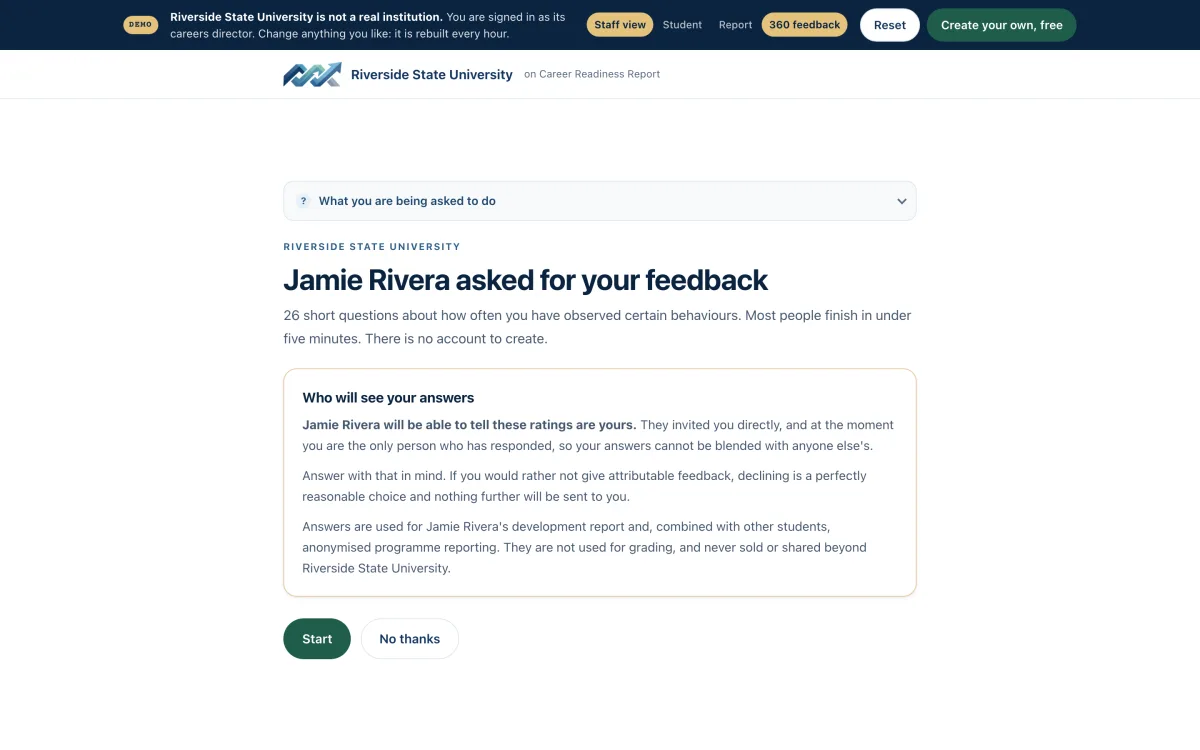
A complete career readiness report synthesizes three distinct data streams: a student's self-assessment, direct observation from an internship supervisor or faculty sponsor, and a factual record of the work experience itself. Relying on only one of these sources yields an incomplete picture. Student self-evaluations measure confidence rather than actual competence. External supervisor feedback measures observable workplace performance but misses the student's internal cognitive growth. The logistical record of the experience grounds both evaluations in a real setting, providing the context required to interpret the subjective data. When a report combines all three inputs, it moves from a simple survey to a defensible artifact for accreditation and program evaluation.
The Experience Record
The foundation of any readiness report is the structural data of the experience. This includes the duration of the role, total hours worked, compensation status, industry sector, and the specific tasks assigned. This data acts as the anchor for the subjective evaluations that follow. A rating on the NACE competency of Professionalism carries different weight if it comes from a 40-hour campus job versus a 400-hour corporate accounting internship.
The experience record provides vital context for institutional reporting. Accreditation bodies require evidence that students are applying academic concepts in appropriate professional settings. By logging the taxonomy of the site and the nature of the work, institutions can filter readiness outcomes by major, industry, or payment status. Tracking unpaid versus paid experiences, for example, allows career services directors to assess whether equity gaps exist in how competencies are developed across different student demographics.
However, the experience record has a strict limitation: it only proves exposure, not skill acquisition. A student who spends a semester in a research lab certainly had the opportunity to practice critical thinking. The logistical record confirms the opportunity existed. It cannot prove the student actually improved their critical thinking skills. To measure learning, the report must incorporate human evaluation.
Student Self-Assessment
The second data input is the student's own evaluation of their skills against the eight NACE Career Readiness Competencies. This typically takes the form of a structured rubric administered at the beginning and end of the experience. Students rate their proficiency in areas like Communication, Equity and Inclusion, and Technology.
The primary value of self-assessment is tracking internal shifts in confidence and professional identity. When a student reflects on their own abilities, they engage in metacognition. They are forced to consider what leadership or teamwork actually looks like in practice.
The weakness of self-assessment is its well-documented lack of reliability regarding actual skill level. Students frequently misjudge their own competence. High-achieving students often underscore themselves due to imposter syndrome, assuming their peers are further along than they are. Conversely, students with limited professional exposure often overestimate their abilities because they do not yet know what a truly professional baseline looks like. For example, a sophomore might rate themselves as an expert in Communication because they text frequently and write decent term papers, entirely unaware of the nuances of corporate stakeholder communication. Similarly, first-generation college students frequently score themselves lower on Leadership and Professionalism simply because they lack prior exposure to corporate office norms, even when they possess strong intuitive abilities. Therefore, self-assessment data should be interpreted strictly as a measure of perceived readiness.
Supervisor and Faculty Observation
To validate the student's perspective, the report must include external, observational data from the professionals managing the student's work. Site supervisors, internship directors, and faculty sponsors provide this 360-degree feedback. They evaluate the student using the exact same NACE rubrics the student used for their self-assessment.
Supervisors provide the most accurate read on a student's actual market readiness. They judge the student against professional standards, not academic ones. If an engineering firm supervisor rates a student highly in Teamwork, that rating reflects an ability to navigate actual workplace dynamics, handle project handoffs, and resolve conflicts with colleagues. The Career Readiness Report platform automates this dual-data collection, sending parallel rubrics to both the student and the supervisor without requiring institutional staff to manually chase down responses.
Supervisor data is not flawless. Managers can only grade what they observe. A supervisor might give a student a mediocre rating in Problem Solving because the student asked a high volume of questions. The supervisor sees this as a lack of independence. They do not see the three hours the student spent testing alternative solutions before finally asking for clarification. Supervisors measure output and efficiency, which can sometimes obscure the invisible process of student learning.
The Value of Triangulation
A report built on a single source of data is a weak document. If an institution only collects supervisor evaluations, it misses the chance to correct a student's imposter syndrome. If it only collects student self-assessments, it risks sending arrogant, underprepared graduates into the workforce while presenting inflated data to accreditors.
Bringing the experience record, the self-assessment, and the supervisor observation together enables precise gap analysis. When the three data streams sit side by side, patterns emerge. If a student rates their Technology skills a 5 out of 5, but the supervisor rates them a 2 out of 5, the report immediately identifies a blind spot. The career services team can use this specific data point to intervene before the student graduates, perhaps by directing them to a technical certification course or a resume workshop to recalibrate how they describe their software proficiencies.
If both the student and the supervisor rate the student's Critical Thinking at a 4 out of 5, and the experience record shows this occurred during a rigorous 300-hour clinical rotation, the institution has highly reliable, validated evidence of career readiness. This triangulated data holds up under the scrutiny of accreditation reviews and provides academic departments with actionable feedback on how well their curriculum translates to the workplace.
The Career Readiness Report is free for every college and university. Open now, in beta.
Create your institution