
Article
What Is a Career Readiness Report?
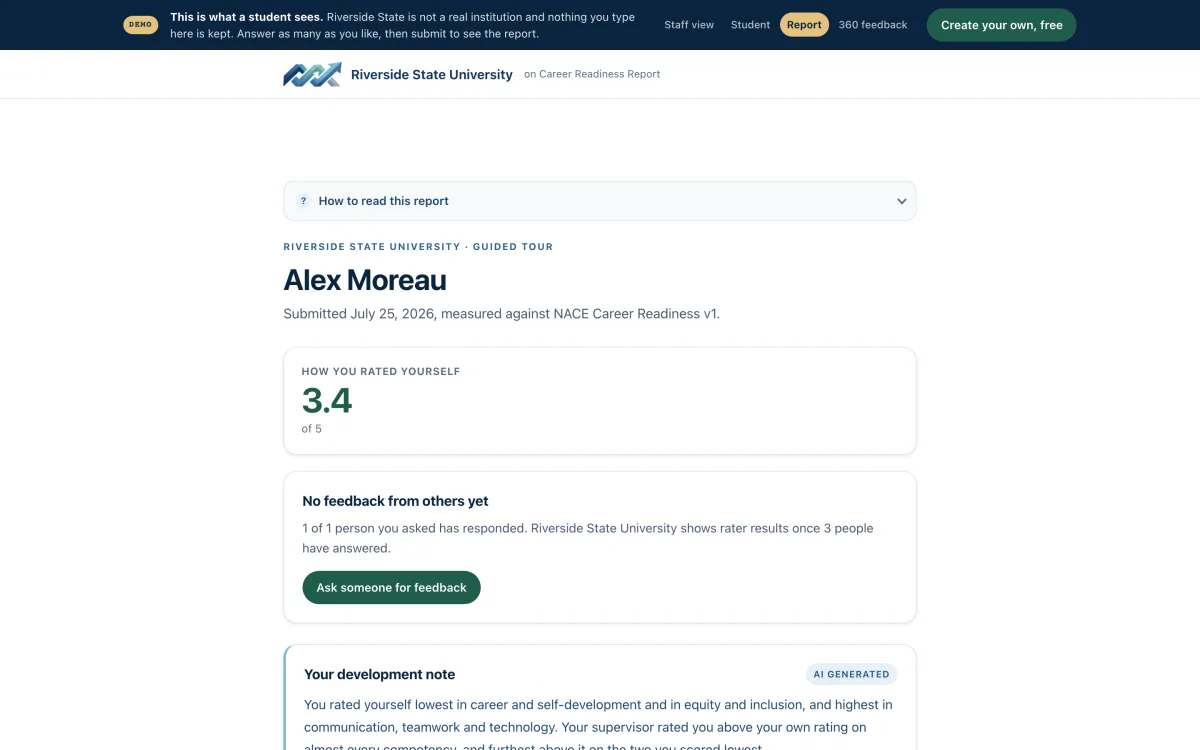
A career readiness report is a per-student record of the eight NACE competencies, evidenced by the student and by the people who supervised their work. It combines a student's self-assessment with direct observational feedback from internship managers, clinical instructors, or campus supervisors. The resulting document translates subjective workplace performance into structured data, providing a standardized view of how a student demonstrates skills like critical thinking, communication, and teamwork in a professional environment.
What the Report Contains
A standard report breaks down performance across the National Association of Colleges and Employers (NACE) framework. Rather than asking broad questions about general ability, the document tracks specific, observable behaviors associated with each of the eight competencies.
For the Professionalism competency, the report does not simply ask if the student was professional. It records whether the student arrived on time, met deadlines, and communicated absences properly. Both the student and the supervisor rate these behaviors on a standardized scale. The document places these two scores side by side.
The report also captures qualitative evidence. A numerical score of a three out of five in Technology becomes much more useful when paired with a supervisor note explaining that the student mastered the required database software but struggled with advanced spreadsheet functions. This combination of quantitative scoring and written feedback creates a complete picture of applied competency.
The Difference Between a Report and a Survey Result
Many institutions collect post-internship surveys, but a survey result is fundamentally different from a readiness report. Surveys typically measure sentiment or aggregate self-reported confidence. They produce data points showing that ninety percent of a graduating class feels prepared for the workforce.
A career readiness report measures observed behavior rather than internal confidence. It relies on 360-degree feedback to validate student perceptions against employer reality. If a student rates their own leadership skills at a five but their supervisor rates them at a two, the report highlights this discrepancy. This gap analysis is the core value of the document.
Surveys are built for aggregate consumption. Reports are built for individual intervention and institutional benchmarking. Generating these individual records at scale requires matching thousands of student inputs with external employer evaluations. The Career Readiness Report platform automates this exact process, matching self-assessments with supervisor evaluations to generate accreditation-ready competency benchmarks for free.
Who Uses the Data
The data serves multiple stakeholders across an institution, each requiring a different level of detail.
Career Services Teams
Career center staff use aggregate report data to identify campus-wide programming gaps. If three hundred engineering students consistently score low on the Communication competency according to their employers, the career center can build targeted workshops on technical writing or workplace presentations. On an individual level, career coaches use the reports during advising sessions to help students translate their internship experiences into resume bullet points and interview answers.
Assessment and Accreditation Coordinators
Accreditors increasingly demand proof of institutional effectiveness and post-graduation outcomes. A career readiness report provides artifact-level evidence of student learning. Instead of relying on proxy metrics like employment rates at graduation, assessment coordinators can pull direct observational data showing how well students apply institutional learning outcomes in real-world settings. This data satisfies requirements for regional accreditors like the Higher Learning Commission or SACSCOC, as well as specialized bodies like ABET or AACSB.
Faculty and Program Directors
Faculty who manage practicums, clinicals, or capstone projects use the reports to evaluate student performance. Relying on unstructured email feedback from fifty different internship supervisors makes grading inconsistent. A standardized report ensures that every student is evaluated against the same rubric, giving faculty a defensible basis for awarding academic credit.
Limitations of the Format
While highly structured, a career readiness report has strict limitations that users must understand.
First, it is not a general aptitude test. It does not measure innate ability or long-term potential. It measures observed behavior in a highly specific setting during a fixed period. A student might score poorly on Teamwork during a remote internship where they worked in isolation, but that same student might excel in a highly collaborative in-person lab environment. The report reflects the context of the work just as much as the skills of the student.
Second, supervisor ratings introduce bias. Employers evaluate students based on their own workplace cultures and expectations. A startup founder and a corporate accounting manager will have different baselines for what constitutes strong Leadership or Professionalism. The data is observational, meaning it is inherently subjective.
Finally, a single report is a snapshot, not a trajectory. To see actual growth, institutions must capture this data multiple times across a student's academic career. A single data point from a sophomore year internship shows where the student was at that moment, but it requires subsequent evaluations to prove that the student developed greater competency before graduation.
The Career Readiness Report is free for every college and university. Open now, in beta.
Create your institution