
Article
When the Student and the Supervisor Disagree
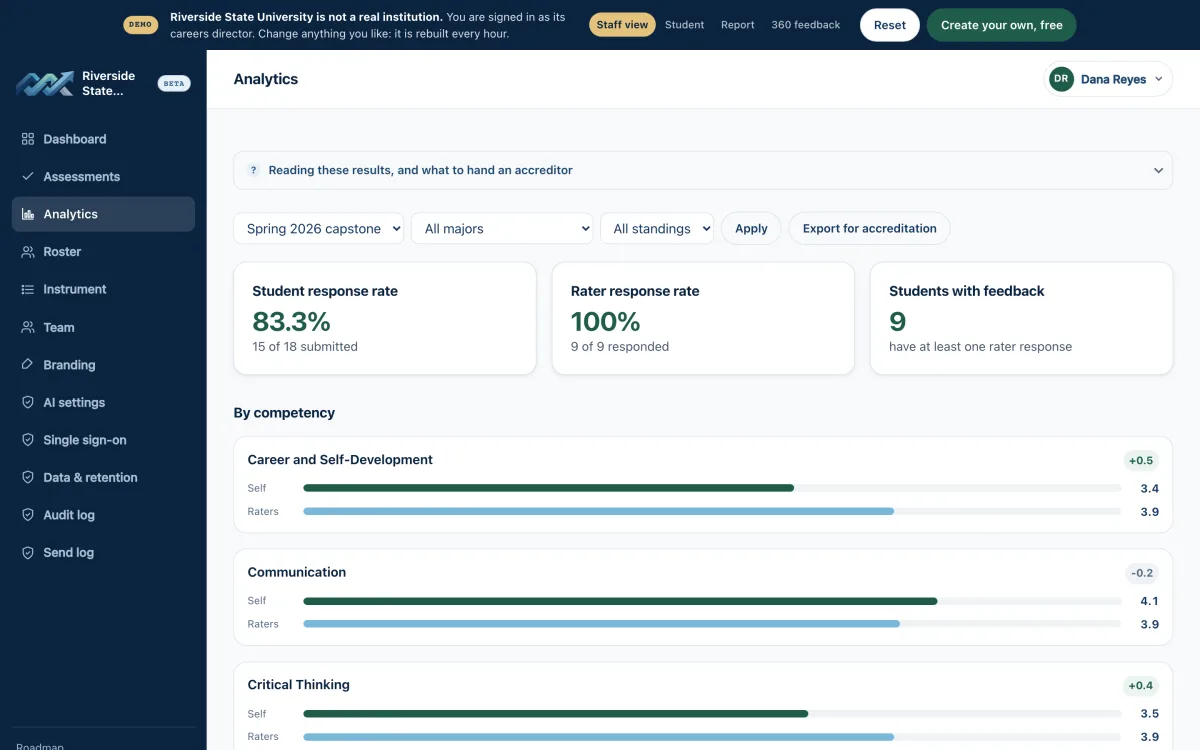
When a student and their internship supervisor disagree on a performance evaluation, the gap between their ratings provides the exact data required for effective advising. Averaging a self-assessment and a supervisor rating into a single composite score destroys the distinct signals of self-awareness and external impact. To build career readiness, an advisor must leave the scores separate and focus the debriefing conversation entirely on where and why those two viewpoints diverge.
The Arithmetic of Masked Problems
Condensing multiple perspectives into a single number hides critical developmental needs. If an intern rates their own critical thinking skills at a five out of five, but their supervisor rates them at a one, the mathematical average is a three. On a standard rubric, a three implies the student meets baseline expectations. That average is a fiction. The reality is far more volatile: the student has severe deficiencies in critical thinking and entirely lacks the self-awareness to recognize them.
Evaluating the raw gap preserves the context. A student's self-assessment measures their internal perception of effort and intent. The supervisor's rating measures the external reality of business impact and professional norms. These are fundamentally different metrics. Blending them assumes they measure the same thing, which compromises the integrity of the data. Reporting should instead place the two numbers side by side, calculating the delta between them to flag the largest discrepancies.
Pattern One: The Overestimation Gap
When a student rates their competencies significantly higher than their supervisor does, the advisor faces a calibration problem. This pattern frequently occurs with the NACE leadership and teamwork competencies. A student might rate themselves highly because they took the initiative to organize a project spreadsheet. The supervisor might rate them poorly because that same student ignored instructions and alienated their peers in the process.
This gap indicates that the student is confusing effort with professional effectiveness. The advisor's objective is to recalibrate the student's definition of success. Begin by asking the student to provide specific, concrete examples of why they chose their high rating. Listen to their rationale, and then introduce the supervisor's perspective as the benchmark for industry standards. The conversation must shift the student from defending their intent to understanding their actual impact on a professional environment.
Pattern Two: The Underestimation Gap
The reverse scenario occurs when the supervisor evaluates the student higher than the student evaluates themselves. Highly competent students often rate themselves harshly, measuring their performance against an idealized version of perfection rather than the practical expectations of an entry-level role.
This pattern presents a critical opportunity to build professional confidence. If left unaddressed, students with this gap may self-select out of rigorous job applications or fail to advocate for themselves in salary negotiations. Because the Career Readiness Report presents supervisor feedback alongside, but distinct from, student self-assessments, advisors can easily identify this pattern. You can place empirical proof of the student's competence on the desk in front of them. The advising task here is validation. Show the student that an objective, experienced professional views their technology or communication skills as highly developed.
Pattern Three: The Acknowledged Deficit
When both the student and the supervisor provide a low rating for a specific competency, there is no disagreement. However, this shared low baseline is a vital signal that requires immediate intervention. The student knows they are struggling, and the employer agrees.
This pattern requires pivoting immediately from evaluation to remediation. If both parties rate the student poorly in data analysis, the advisor must help the student find concrete ways to build that skill before graduation. This might involve enrolling in a specific quantitative course, securing a targeted on-campus job, or joining a faculty research lab.
There is a real limit to what advising can accomplish in this scenario. Sometimes an acknowledged deficit simply means the internship required technical skills the student had not yet been taught. If this pattern appears consistently across multiple students in the same academic program, it is no longer an individual advising issue. It is a curriculum gap. Faculty running the internship program must use this aggregate data to adjust prerequisite coursework.
Structuring the Debrief
To make these gaps actionable, the visual presentation of the data must prioritize the delta. Avoid bar charts that stack the scores. Instead, use a dual-plot axis or a simple table that highlights the mathematical difference between the two ratings. If the difference is greater than one full point on a five-point scale, flag it for discussion.
Start the debriefing session by explicitly stating that discrepancies are normal and expected. Students often view a lower supervisor score as a punitive grade. Framing the gap as a difference in vantage points reduces defensiveness. Instruct the student to pick the two largest gaps on their report and write a brief reflection on why the supervisor might have seen things differently.
By isolating the disagreement, you force the student to practice perspective-taking. They must step outside their internal narrative and consider how their actions register with managers and colleagues. That analytical step is the actual mechanism of career readiness.
The Career Readiness Report is free for every college and university. Open now, in beta.
Create your institution