
Article
Using a Career Readiness Report as Accreditation Evidence
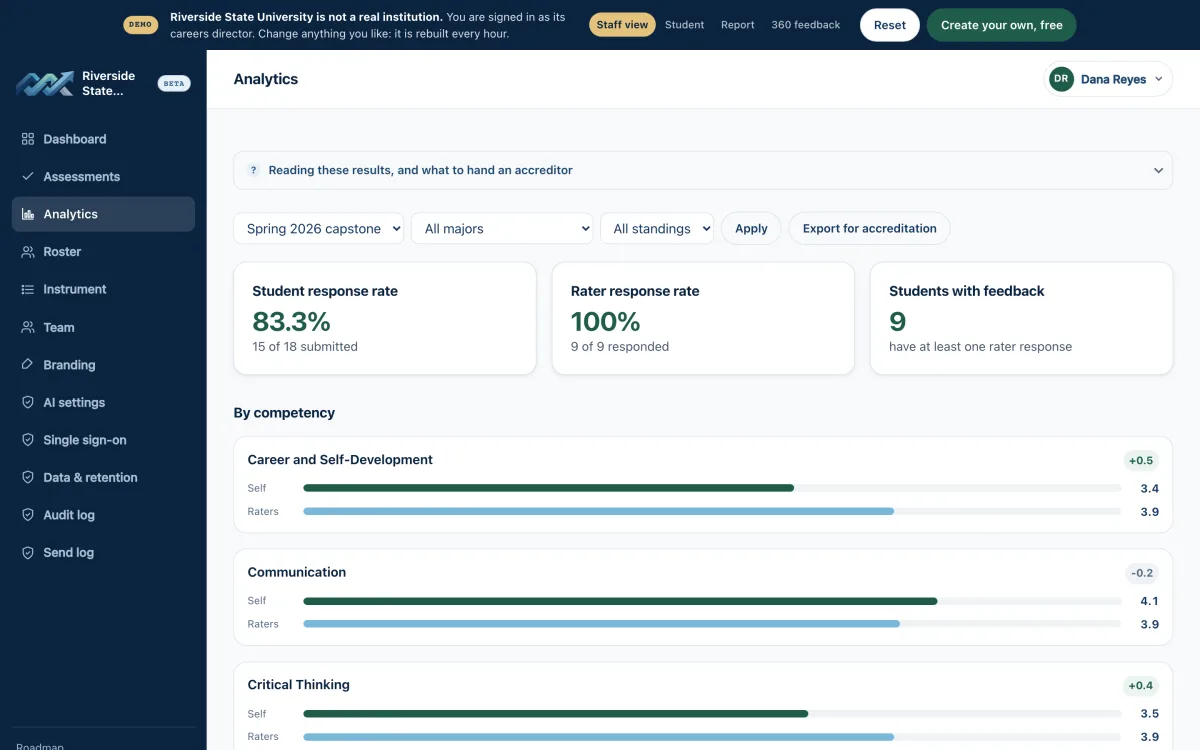
A career readiness report becomes accreditation evidence at the moment it is attached to four things: a stated outcome, a measure aligned to that outcome, results reported against a threshold, and a documented decision that followed from the results. Absent any one of those, it is a data dump. Present all four, and it is admissible evidence for professional and behavioral outcomes such as communication, teamwork, and professionalism. It is not evidence that students can size a heat exchanger or evaluate audit risk, and reviewers will say so if you imply otherwise.
The chain reviewers check
Every accreditor runs the same logic under different vocabulary. AACSB's 2020 Standard 5 asks for learning goals, systematic assessment, and evidence of curriculum change. ABET Criterion 4 asks for a documented, regularly applied process of assessment and evaluation against the Criterion 3 student outcomes, with results used for continuous improvement. HLC Criterion 4.B, SACSCOC Standard 8.2.a, and MSCHE Standard V all ask for outcomes, evidence of student achievement, and use of results.
The failure mode is almost never missing data. It is a broken link between the data and a decision. Review teams see programs that assess diligently every year, tabulate the numbers, and take no action other than "continue to monitor." That reads as compliance, not improvement, and it draws a recommendation.
Where a career readiness report fits
The outcome
Map the report's competencies to outcomes you have already adopted, and do not adopt new ones to fit the instrument. If your program outcomes are the ABET 1 through 7 set, teamwork data maps to Outcome 5, communication to Outcome 3, and ethical and professional responsibility to Outcome 4. If you are an AACSB school with a learning goal phrased as "graduates communicate effectively in professional settings," the supervisor ratings on oral and written communication belong under that goal and nowhere else. Reviewers notice when a measure has been retrofitted to an outcome it does not actually address.
The measure
Here is the distinction that determines how much weight the evidence carries. A student rating their own teamwork is an indirect measure. A site supervisor rating observed performance against a behavioral rubric is generally accepted as direct evidence, because a person who watched the work is scoring the work. ABET program evaluators have accepted employer evaluations of interns as direct assessment when the evaluation uses a rubric tied to the outcome and the program can show how ratings map to performance levels. They have also rejected them when the form was a five-point satisfaction scale with no anchors.
So the rubric matters more than the platform. Anchored performance levels, three or four of them, with observable descriptions. Include the instrument verbatim in your appendix. If your supervisor form asks "rate the student's professionalism, 1 to 5," that is a satisfaction survey and it will be treated as indirect.
The results
Report n, the response rate, the target, and the distribution rather than only the mean. A mean of 4.2 on a five-point scale tells a reviewer nothing about how many students fell below acceptable. "82 percent of 147 evaluated students met or exceeded the proficient level on written communication, against a target of 85 percent" is a finding. It also gives you something to act on.
Expect ceiling effects. Site supervisors rate generously, and it is common for 90 percent or more of students to clear the bar on every competency except written communication and initiative. When every competency passes, either your target is too low or your rubric does not discriminate. Say which one you concluded and what you did about it.
The use of results
This is the part that is usually thin. Write the action, the date, the owner, and the re-measurement point. "Spring 2024 supervisor data showed 61 percent proficiency on written communication against an 80 percent target. Faculty added two client-facing memo assignments to MGT 340 in Fall 2024. Re-measured Spring 2026." Two sentences, and the loop is closed on paper.
Where it does not substitute for direct disciplinary assessment
No career readiness instrument samples your curriculum. A supervisor rates what the placement happened to require, and placements are not comparable to each other. A student who spent a summer in quality control and a student who spent it in market research were assessed against different work, by different raters, with different standards. That variance is tolerable for behavioral competencies, which generalize. It is fatal for disciplinary outcomes, which do not.
Keep embedded course assessment, capstone rubrics, and exam item analysis as the primary evidence for technical outcomes. The career readiness data is corroborating evidence for the professional outcomes and triangulating evidence elsewhere. A useful framing in the self-study: this measure tells us how graduates perform in supervised professional settings, and course-embedded measures tell us what they know.
The coverage problem, stated plainly
If 40 percent of your majors complete a supervised experience, your career readiness data describes 40 percent of your majors, and probably the more motivated 40 percent. Report the participation rate rather than letting a reviewer discover it. Then describe what covers the remainder: a capstone team project scored on the same rubric, a required professional practice course, or a plan to expand placements. Instruments that collect structured 360 feedback against the eight NACE competencies, including the Career Readiness Report, can generate the rating distributions and external benchmarks, but none of them solve a coverage gap in who participates.
Assembling the exhibit
One table per outcome, on one page. Columns: outcome, measure and instrument, population and n, response rate, target, result, action taken, date, next measurement. Append the rubric and a sample completed evaluation with identifiers removed. Attach the minutes of the faculty meeting where the results were discussed, because that document is what turns a spreadsheet into an assessment process. Reviewers read the minutes.
The Career Readiness Report is free for every college and university. Open now, in beta.
Create your institution